Author: jwaddingham

  • Work with me

    Work with me

    If you need help with your startup, charity, social enterprise or agency, I am available on a short term or ongoing basis to work directly with your teams as a product consultant.

    Contact me via LinkedIn or via the website.

    Photo via https://www.flickr.com/photos/hellobeautifulworld/5453488478/in/faves-96297851@N00/

    I can help with

    Product Strategy and vision

    Growth tactics

    Idea generation, validation & discovery

    Building high performing (product) teams

    All things product management

    I have experience of…

    High growth consumer websites 📈

    Speaking to actual customers 😎

    Mobile app development (iOS and Android) 📱

    Agile development 🌊🚫

    AB and MVT testing 🤓

    Analytics implementation and use (Google Analytics, Mixpanel, Segment, KissMetrics) 💯

    Workflow mapping and processes 🔀

    Ecommerce — conversion optimisation and fraud prevention 💰

    Running effective workshops and meetings 🤹‍

    Vendor comparison and selection ⚖️

    Product discovery 🕵️‍

    Leveraging network effects for organic growth 🕸

    Media training 🎤

    API integrations (particularly Facebook APIs) 🔑

    Failing fast and learning quickly🤦‍

    The brilliant UK charity sector 👊

    Crowdfunding 💁

    And a lot of other random things like… presenting awards evenings. See my full work history on LinkedIn.

  • On Mind the product 2015 #mtpcon

    Last Friday I spent the day (incidentally my first Friday working for a couple of years) at the annual Mind the Product conference. As the name suggests, it’s all about product. So when we weren’t debating over the collective noun for Product Managers (an ‘Epic‘ was the preferred choice), we heard all sorts of product wisdom from wise product people.

    My biggest takeaway was from the last session of the day, by Ken Norton from Google Ventures. His point was to challenge everyone to think big. Think how you can grow your product by 10X not 10%. And that, in some cases, it might actually be easier to even think that way to come up with revolutionary ideas that will really change the world (or your product). This is the Google X view, which I saw Astro Teller talk about at SXSW earlier this year (which I still haven’t blogged about, oops), and it does really force you to expand your horizons. Next meeting I have about numbers, I’ll see what happens when we look for 10X growth…

    Anyway, as I’ve written about before, I like to use Storify to collect notes from the sessions and give me at least some hope of referring back to them after the conference is over. So here’s all of those storifys (storifies?) in their glorious embedded detail for you (in reality, just me) to enjoy…


    https://storify.com/jon_bedford/mind-the-product-2015-mtpcon

    https://storify.com/jon_bedford/lessons-on-product-from-spotify-at-mtpcon

    https://storify.com/jon_bedford/afternoon-sessions-at-mtpcon

    https://storify.com/jon_bedford/last-sessions-at-mtpcon-2015

  • On thanking

    Earlier in the Summer, we knew we were about to reach our first big Yimby milestone – raising over £1 million. This was pretty exciting for us, and we wanted to find a way to talk about it and do something to celebrate that. The obvious thing was to do some sort of press release (which we did – see coverage here and here), but we also felt that celebrating ourselves was a bit too, well, self-congratulatory and it was our users who were the ones to be celebrated. So we tried to come up with some ideas for doing something a bit different.

    At that time, my wife (she’s an awesome freelance copywriter at Wise copy) was working for a charity client on re-writing their thank you letters and I was inspired by how much of an emotional reaction I was getting from reading these letters. I hadn’t quite appreciated the stark difference between a well-written thank you letter and a, well, bog standard thank you. So it made me think – given that our users are the ones who raised £1 million, shouldn’t we be thanking them and not ourselves? Wouldn’t it be great to personally write to them, and thank them? I mean, when do you ever receive anything in the post from a website. Let alone a personal, hand written note. (All those fundraising conference sessions on DM have clearly imprinted on my subconscious too).

    Anyway, we decided it would be a good idea to write to all our successful project creators and thank them. Personally. All 500 odd of them. [Gulp]

    How to write a great thank you

    I set myself the challenge of writing the thank you letter, and having little experience of this personally, I went to the obvious first place to learn more: sofii.org. In particular, I read through all the before and after examples on the Sample thank-you letters for you to swipe page (why reinvent the wheel eh!) and tried to apply their lessons to the letter I wanted to write. I tried to focus on thinking about how I wanted the recipient to feel – which was gratitude for their efforts. And I mean genuine gratitude: we were genuinely grateful that people had used Yimby to make something good happen and I wanted to express that, and show how they had formed part of a much greater impact than they might have realised.

    My thank you letter postcard

    I originally wanted to write a letter, but that would have taken way too long, so we decided to send a postcard.

    The postcard (designed by Kate) was meant to show the range of people using Yimby and reinforce the message of *thanks*. “Thanks a million” was an obvious title to use.


    Thanks a million

    As there’s not much room on a postcard, I had to go through a few iterations to edit the letter down to its core whilst still trying to keep some impact. And here’s what we eventually went with:

    Dear [firstname],

    Because of you, and the efforts of hundreds of other people like you, over £1 million has now been raised to make hundreds of good things happen on Yimby.com.

    You were one of the first people to use Yimby, and we couldn’t have done it without you – thanks a million.

    Jonathan, Yimby Product Manager [signed from whichever member of the team wrote it]

    Ps – You can now find projects near you at Yimby.com

    Hopefully it meets and respects the rules of Lisa Sargent on sofii, but I was pretty happy with it. But then came the daunting task of writing about 500 of these -because it *had* to be hand-written to have the effect I wanted. We didn’t quite appreciate at the time that this would take *ages*, despite divvying up the work between the Yimby team (of 4-5 at that time). Not to mention the time of adding first class stamps to each postcard. I mean, we couldn’t go to all that effort to make it personal and then use franking, it just wouldn’t have felt right.

    The impact

    The goal of this wasn’t to drive visits to the site, get more pages or pledges; it was to create a feeling. Put that in your ROI pipe and smoke it!

    We knew Yimby was growing because of word-of-mouth, and that people who’d used the product were telling their friends to use it too. So if people were thanked properly (albeit not timely – that was one thing we couldn’t do as the milestone was about our platform, not their project) they would potentially be warmer to us, and tell more people. And you know what, as we wrote these cards and read the story behind every single project (personalising the copy to them if we could) it became quite an emotionally involved task: I felt every thank you that I wrote. Sincerely felt it. And if I felt it, I was sure the recipient would too.

    My ultimate goal would have been if someone stuck up a postcard on their fridge – putting us in the heart of their home – and that everyone who saw that postcard asked about it. Try measuring that digital marketers! Still, we knew that a few people might talk about their card on social, and their reaction would give us a barometer as to whether they appreciated it. In this case, success looked like appreciation. And, as you can see from the tweets, people appreciated it:

    https://twitter.com/MariceCumber/status/507630520621342720

    (despite me smudging the writing :/)

    And there were plenty more tweets too. We decided to not try and have a hashtag to pull the tweets together or have clever bit.ly links on the cards to measure clicks as it wasn’t about that, it would have felt too much like “marketing”. This wasn’t a campaign, it was a thank you. Simple as that.

    What did we learn?

    1. People appreciate being thanked (duh)
    2. There’s a knack to writing a good thank you (double duh)
    3. Hand writing thank-yous takes forever. In hindsight we might have printed the copy and hand signed each one instead.
    4. Sometimes you don’t need to worry about measuring the impact: just because you can’t measure something, it doesn’t mean it’s not worth doing
    5. Websites can do DM too: it outperformed email by a long way in this instance
    6. Doing the obvious thing is obvious. And usually easy. Thinking differently is hard, and following up on that is even harder
    7. Some of our team have terrible handwriting

    Thanks for reading 😉

    So there you have it. Inspired by a couple of Sophie’s (sofii.org and @sophdea) we thanked a few hundred people for raising over a million pounds on Yimby. And it felt great. For us, and them too.

    For more on thanking, I would recommend reading this article on How to write a better thank-you letter (and why it matters) (which I annoyingly didn’t find at the time), a new sofii article on Does thanking really work? (bet you can’t guess what the answer is) and a great post from Lisa Clavering on great and not-so-great thanking experiences.

    Thanks to Jack, Kate, Ben, Jacs, Camilla and Cat for helping to write ALL THE CARDS.

    *update*

    I forgot to give a mention to two organisations who’d send me great thank-yous recently:

    The first is Campaign Bootcamp, who wrote a lovely card based on what I’d been talking about the fundraising workshop I gave there. Ironically, I didn’t even mention thanking in it as the primary goal was to get people to feel confident in asking

    The second is Nordoff-Robins. I did an off-the-cuff fundraiser for them one afternoon, and they were in contact the next day to say thanks. And they sent a card too. Lovely. I only raised £75, yet I’ve never heard from some other charities I’ve fundraised for where I raised significantly more money.
     

  • On presentation skills

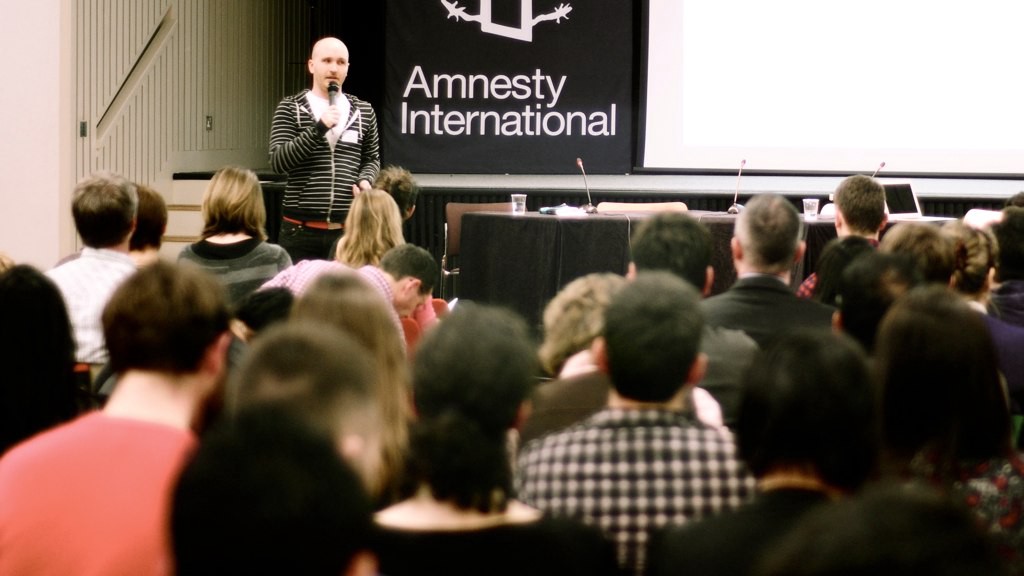
    Our lovely People Team (don’t call them HR) have recently started an internal learning curriculum where anyone in the office can offer to give a talk on any topic and anyone else can sign up to attend. There’s a wide range of learning on offer, from meditation and mindfulness to Excel training and intros to html and CSS. The topics are both broad and niche, if that’s technically possible. I offered to do one on presentation skills as it’s something I’m good at, I enjoy doing training and it’s something I know most people don’t like. So these are my top tips…

    My top 5 presentation tips

    1. Choose your words carefully

    You set the tone of your talk through the words you use on your slides. Be as concise as possible and choose interesting words over dull ones. It may sound obvious, but also get someone else to proof read for spelling or grammatical errors. If you’re presenting to grammar or spelling pedants, you lose them as soon as they spot a typo.

    2. Never reveal more than one line of text

    A common mistake people make is to fill slides with text. This just means half your audience will read the slides and not listen to you. And you can compound this by reading each line out, which just makes a presentation feel like someone’s reading a blog post out loud. Which is dull. Try to focus on one point at a time and bring your audience with you. Use the *appear* animation in powerpoint to stack points and reveal them one at a time.

    3. Remember the rule of three

    For this I’ll just quote wikipedia (albeit a wikipedia entry that needs a citation):

    The rule of Three is a writing principle that suggests that things that come in threes are inherently funnier, more satisfying, or more effective than other numbers of things

    4. Interact with your audience

    Make eye contact. Look around the room. Ask questions. Sitting for an hour listening to someone talk can be dull if you don’t feel like they’re engaging with you. The old “stand up if you have/do/think/believe something” trick is a good one to use. Getting people to stand up stimulates them, makes them active instead of passive and is a common way to engage with an audience.

    5. Speak slower than normal

    This is one I struggle with, and one I notice a lot of others do too. And it’s hard, as you’re usually nervous before giving a talk and the adrenaline kicks in. But when you speak quickly, it’s hard for people to catch up. Put slides in your deck to linger over and help you pause. Especially if it’s an important point. Take deep breaths as a way to slow down, and walk around if you can.

    6. Check out my slides 😉

    As I spent a long time coming up with some slides – I mean, they had to be good if I’m supposed to be the trainer! – I thought I may as well share them and see if anyone else has any good tips to add. Obviously the slides don’t mean as much without my commentary, but I’ve done a bit of editing to make it easier to follow on slideshare. And that’s another top tip – if you’re sharing slides online, do a version of the slides with more explanations so they make sense without a spoken commentary. It has lost all my fancy fonts though, so try to pretend that it looks a little bit prettier than arial… :/

    I delivered the training as a two part course, where the second part was getting people to present on something they knew about to make them feel comfortable about presenting. And the selection of presentations delivered was awesome – from the story of the F1 season so far, a guide to winter cycling and how to survive a zombie apocalypse – and it was great to see the guys take my advice on board and be much more confident presenters. Training win!

    The funny thing about putting this talk together was that I realised I often didn’t take my own advice and it made me work a bit harder on putting more structure to my talks and thinking more about the delivery. I even nabbed some slide templates from my presentation skills talk for an external talk, and you can see the before and after versions on my previous blog post.

    My fave presentation tips from others

    As for inspiration, my favourite blog post on giving presentations is probably on the Bolt Peter site – I’ve definitely taken a lot from it and I think it’s the single most useful thing anyone could read about presenting. I also found this TED talk on the structure of storytelling really compelling, but I’ve yet to manage to shoehorn in something as exciting as the iPhone launch into anything I’ve presented. Yet…


  • On social, mobile and awards

    Over the last few months I’ve given a few talks, mainly on the themes of social and mobile (with the notable exception of an awards ceremony). I’ve been talking about this theme (read: going on about it) for a while, but it’s been good to pull together a couple of presentations and a blog post to sum up my thoughts. Maybe I can start talking about something else soon instead…

    Going mobile, being social

    Anyway, here are the slides from the IoF Convention this Summer where I talked about going mobile and being social alongside Lynn Sutton from Facebook:


    And if they don’t make that much sense without a commentary, I also did an interview with Ravinol from Be Inspired Films on the topic:

    Growing your audience with mobile and social

    I also gave a similar  talk at the IoF iFundraising conference in September, trying to focus on more practical steps that charities could take on board. I blogged about these the IoF site and the JG blog as 6 tips for growing your audience on mobile and social, and the slides are below:


    During the day I gave a short interview to Rebecca from charity digital news, where I was thinking more about what I’d do if I was a smaller charity trying to take my advice. Read that over here.

    The JG Awards

    By far and away the most fun speaking gig I get to do is the JG Awards. This year was our fifth event and my fifth year MC-ing, so it feels like an old friend I only get to speak to once a year. It was another amazing night, full of incredible stories and possibly a few dodgy puns too.  Here’s the video just in case you want to see my gaffe of starting to read the announcers script instead of mine when first getting to the stage – I promise I wasn’t just saying hello to the laydeeez….


    http://new.livestream.com/accounts/864795/events/3394360/videos/63103806/player?autoPlay=false&height=360&mute=false&width=640

  • My notes from #f8 – anonymous login, mobile likes and a #sherylselfie

    I’ve been lucky enough to be in San Francisco this week for Facebook’s F8 developer conference. It’s been a really interesting experience altogether, being in the epicentre of the startup world and visiting the likes of Pinterest and Facebook’s offices to see what it’s like. But F8 was a conference on a whole new level – the scale, slickness and content were of a level I’ve not experienced before. It was a little bewildering at times, especially given the vast amount of information being shared, but I tried to capture as much content as I could using Storify, Flickr, Twitter, and (of course) Facebook so I had some notes to look back on and figure out what it meant for us.

    Facebook announced so much that it’s pretty hard to distil it, but I tried to pick out the most useful titbits for each part and storify the hell out of it. But possibly the most exciting part was saying hello to Sheryl Sandberg and getting a #sherylselfie.


    As a relatively new parent of a lovely little girl, I love what she’s doing with the #banbossy campaign: she’s a great role model for girls. But anyway, apart from that excitement, here’s all the notes I took from three chunks – the keynote, the latest on building stuff and what’s new in growth.

    Keynote notes (key notes?)


    What’s new about building stuff

    How to grow with Facebook

    So, what does that all mean?

    In the unlikely event that you’ve read this far, er, I, er, dunno. Still haven’t quite digested the epic amounts of information shared to think about the big picture. But I do know that we’ll have a fair bit of work to do off the back of this, that some things may make our lives a little harder, but plenty will make our lives easier too – and probably help us help people raise that bit extra via Facebook.

    I also know that I felt incredibly lucky to be invited and to be able to fly halfway across the world to attend. I hope I get invited back next year…

  • The shocking truth about shocking charity videos

    LinkedIn appears to have opened up it’s publishing platform to people who aren’t famous influencers (ie, people like me), so I wrote a post over there to see what it’s like. And it’s, well, like publishing anywhere, except you do seem to get greater visibility than you might otherwise  – or at least for me it appears to have many more views than most blogs I write here. Which isn’t saying much, to be honest.

    Have a read here: the shocking truth about shocking charity videos.

  • Play this post, make sweet music

    Make some music. Click in the frame below and press any key from a-z.

    http://www.patatap.com/

    Tapping ‘w’ and ‘e’ at around 105 BPM makes a nice ambient house soundtrack, if that’s your thing.

    This piece of internet genius is brought to you by patatap.

  • The JustGiving numbers behind #nomakeupselfie

    Now that we’ve had the selfies, and the blogs against selfies, and the blogs for selfies, and the blogs about what charities can learn from selfies, there’s really not much left to say about the #nomakeupselfie campaign. So I won’t bother (or perhaps leave it to my sessions at Fundraising Online or the IoF National Convention) and direct you to Madeleine’s blog for a fab collection of selfie-themed articles and blog posts to get up to speed.

    Instead, I’ll just share some numbers from JustGiving that reinforce just how powerful it was, and what a viral campaign does to your analytics. Over a million was donated on JustGiving to selfie related campaigns, which is impressive enough, but how that happened is just as interesting…

    • We saw an increase of 15,743% in the number of mobile direct donation shares compared to previous period*
    • An increase of 7,406% in the number of desktop direct donation shares
    • 30% of mobile direct donors shared their donation afterwards and 26% of desktop direct donors shared their donation (again, mobile users share more)
    • An increase of 47,331% in the amount donated from shares after a direct donation on mobile
    • An increase of 430,702% in the amount donated from shares after a direct donation on desktop
    • An increase in visits of 50%, with a a peak of 9,000 concurrent users on the site at the busiest period (22.00 on Wednesday – is your Ops team on call 24/7?)
    • Overall, 2% of desktop donations and 7% of mobile donations were made from post donation sharing to social networks – donations which would not have been made were it not for the social sharing tools tightly integrated to our donation process. This doesn’t count visits as a result of fundraising page or charity profile shares before donating, so the numbers would be even higher in reality. Sonny’s law in action
    • 51% of visits on peak day were from mobile, 36% from desktop and 13% tablet. I’d guess that’s the most mobile heavy day we’ve ever had, although January 2014 was the first month where we had more traffic from mobile alone than desktop, so it’s part of a wider trend.
    • Just under 500,000 visits from Facebook from over 11 million impressions on Facebook on Wednesday 19th alone.

    And pretty much every graph looks like the one below:

    Facebook distribution graph


    So yes, if you hadn’t realised it already, #nomakeupselfie was big. Big.

    What else can we learn?

    Build for mobile, build for shares, build to scale.

    Watch the video over on the JG blog for more.

    *All dates are from Tuesday 18th to Sunday 23rd March (the appeal spiked on Wednesday 19th) compared to previous period of Tuesday 11th – Sunday 16th March.

  • On innovations in digital fundraising

    Today I gave a presentation  to a bunch of young charity sector professionals who are part of the Charity works scheme. If you’ve never heard of it, it’s the UK charity sector’s graduate scheme and is a great thing. Check them out (and then come back here).

    As part of their training, they regularly come together to hear from various people in the sector about various things, and I was flattered to be put in touch with them by Lucy Gower (that’s @LucyInnovation to you and I) as someone who could talk about innovation in digital fundraising. Given the context was for people who perhaps haven’t had much exposure to fundraising generally, I wanted to go back to basics before showing the new shiny stuff. As basically, the new and shiny stuff is just a new way of doing the old tricks that have worked for years. In summary, it’s always about storytelling, it’s just the form of the storytelling that changes.

    Personally, I found it quite interesting to reflect on this and what I thought was innovative, and what I believe to be the big (technology) trends that digital fundraising needs to be aware of. Funnily enough, one of my starting points was Mark Phillip’s excellent collection of old charity ads on Pinterest. They are just really, really good, and point to what *good* fundraising is about, be it digital or analogue or whatever.

    So for me, the most innovative things in digital fundraising aren’t really that innovative, in a way. They just stay true to the basics of fundraising – telling a good story – and they use the opportunities new tech and digital give us to tell those stories in different, ever more engaging ways. Which is hardly a groundbreaking insight, and one I first spoke about four years ago

    As part of trying to get people to think about how they would tell their charity’s story, I took a couple of the old ads and tried to imagine how they might look if shared on Twitter. It was fun, if surprisingly hard, to take those ads and think about how they would be communicated in 140 characters. But I’d recommend it as an exercise in thinking about how to craft an elevator pitch, and is quite like a piece of advice from the head of brand at Facebook that’s stayed with me for a while – when building an app or campaign, start from the point of view of what gets shared in the newsfeed, given that’s where most people will come across your campaign (depending on the type of campaign, obviously). I’d highly recommend you read their advice.

    Hopefully the cohort who saw my talk will now think more about how they can tell their charity’s story too – be it in 140 characters, 6 seconds or over the course of a longer, integrated campaign. Ultimately, that’s what it’s about for me.

    Have a look at the slides below: