Category: Technology

  • My notes from #f8 – anonymous login, mobile likes and a #sherylselfie

    I’ve been lucky enough to be in San Francisco this week for Facebook’s F8 developer conference. It’s been a really interesting experience altogether, being in the epicentre of the startup world and visiting the likes of Pinterest and Facebook’s offices to see what it’s like. But F8 was a conference on a whole new level – the scale, slickness and content were of a level I’ve not experienced before. It was a little bewildering at times, especially given the vast amount of information being shared, but I tried to capture as much content as I could using Storify, Flickr, Twitter, and (of course) Facebook so I had some notes to look back on and figure out what it meant for us.

    Facebook announced so much that it’s pretty hard to distil it, but I tried to pick out the most useful titbits for each part and storify the hell out of it. But possibly the most exciting part was saying hello to Sheryl Sandberg and getting a #sherylselfie.


    As a relatively new parent of a lovely little girl, I love what she’s doing with the #banbossy campaign: she’s a great role model for girls. But anyway, apart from that excitement, here’s all the notes I took from three chunks – the keynote, the latest on building stuff and what’s new in growth.

    Keynote notes (key notes?)


    What’s new about building stuff

    How to grow with Facebook

    So, what does that all mean?

    In the unlikely event that you’ve read this far, er, I, er, dunno. Still haven’t quite digested the epic amounts of information shared to think about the big picture. But I do know that we’ll have a fair bit of work to do off the back of this, that some things may make our lives a little harder, but plenty will make our lives easier too – and probably help us help people raise that bit extra via Facebook.

    I also know that I felt incredibly lucky to be invited and to be able to fly halfway across the world to attend. I hope I get invited back next year…

  • The shocking truth about shocking charity videos

    LinkedIn appears to have opened up it’s publishing platform to people who aren’t famous influencers (ie, people like me), so I wrote a post over there to see what it’s like. And it’s, well, like publishing anywhere, except you do seem to get greater visibility than you might otherwise  – or at least for me it appears to have many more views than most blogs I write here. Which isn’t saying much, to be honest.

    Have a read here: the shocking truth about shocking charity videos.

  • Play this post, make sweet music

    Make some music. Click in the frame below and press any key from a-z.

    http://www.patatap.com/

    Tapping ‘w’ and ‘e’ at around 105 BPM makes a nice ambient house soundtrack, if that’s your thing.

    This piece of internet genius is brought to you by patatap.

  • The JustGiving numbers behind #nomakeupselfie

    Now that we’ve had the selfies, and the blogs against selfies, and the blogs for selfies, and the blogs about what charities can learn from selfies, there’s really not much left to say about the #nomakeupselfie campaign. So I won’t bother (or perhaps leave it to my sessions at Fundraising Online or the IoF National Convention) and direct you to Madeleine’s blog for a fab collection of selfie-themed articles and blog posts to get up to speed.

    Instead, I’ll just share some numbers from JustGiving that reinforce just how powerful it was, and what a viral campaign does to your analytics. Over a million was donated on JustGiving to selfie related campaigns, which is impressive enough, but how that happened is just as interesting…

    • We saw an increase of 15,743% in the number of mobile direct donation shares compared to previous period*
    • An increase of 7,406% in the number of desktop direct donation shares
    • 30% of mobile direct donors shared their donation afterwards and 26% of desktop direct donors shared their donation (again, mobile users share more)
    • An increase of 47,331% in the amount donated from shares after a direct donation on mobile
    • An increase of 430,702% in the amount donated from shares after a direct donation on desktop
    • An increase in visits of 50%, with a a peak of 9,000 concurrent users on the site at the busiest period (22.00 on Wednesday – is your Ops team on call 24/7?)
    • Overall, 2% of desktop donations and 7% of mobile donations were made from post donation sharing to social networks – donations which would not have been made were it not for the social sharing tools tightly integrated to our donation process. This doesn’t count visits as a result of fundraising page or charity profile shares before donating, so the numbers would be even higher in reality. Sonny’s law in action
    • 51% of visits on peak day were from mobile, 36% from desktop and 13% tablet. I’d guess that’s the most mobile heavy day we’ve ever had, although January 2014 was the first month where we had more traffic from mobile alone than desktop, so it’s part of a wider trend.
    • Just under 500,000 visits from Facebook from over 11 million impressions on Facebook on Wednesday 19th alone.

    And pretty much every graph looks like the one below:

    Facebook distribution graph


    So yes, if you hadn’t realised it already, #nomakeupselfie was big. Big.

    What else can we learn?

    Build for mobile, build for shares, build to scale.

    Watch the video over on the JG blog for more.

    *All dates are from Tuesday 18th to Sunday 23rd March (the appeal spiked on Wednesday 19th) compared to previous period of Tuesday 11th – Sunday 16th March.

  • On innovations in digital fundraising

    Today I gave a presentation  to a bunch of young charity sector professionals who are part of the Charity works scheme. If you’ve never heard of it, it’s the UK charity sector’s graduate scheme and is a great thing. Check them out (and then come back here).

    As part of their training, they regularly come together to hear from various people in the sector about various things, and I was flattered to be put in touch with them by Lucy Gower (that’s @LucyInnovation to you and I) as someone who could talk about innovation in digital fundraising. Given the context was for people who perhaps haven’t had much exposure to fundraising generally, I wanted to go back to basics before showing the new shiny stuff. As basically, the new and shiny stuff is just a new way of doing the old tricks that have worked for years. In summary, it’s always about storytelling, it’s just the form of the storytelling that changes.

    Personally, I found it quite interesting to reflect on this and what I thought was innovative, and what I believe to be the big (technology) trends that digital fundraising needs to be aware of. Funnily enough, one of my starting points was Mark Phillip’s excellent collection of old charity ads on Pinterest. They are just really, really good, and point to what *good* fundraising is about, be it digital or analogue or whatever.

    So for me, the most innovative things in digital fundraising aren’t really that innovative, in a way. They just stay true to the basics of fundraising – telling a good story – and they use the opportunities new tech and digital give us to tell those stories in different, ever more engaging ways. Which is hardly a groundbreaking insight, and one I first spoke about four years ago

    As part of trying to get people to think about how they would tell their charity’s story, I took a couple of the old ads and tried to imagine how they might look if shared on Twitter. It was fun, if surprisingly hard, to take those ads and think about how they would be communicated in 140 characters. But I’d recommend it as an exercise in thinking about how to craft an elevator pitch, and is quite like a piece of advice from the head of brand at Facebook that’s stayed with me for a while – when building an app or campaign, start from the point of view of what gets shared in the newsfeed, given that’s where most people will come across your campaign (depending on the type of campaign, obviously). I’d highly recommend you read their advice.

    Hopefully the cohort who saw my talk will now think more about how they can tell their charity’s story too – be it in 140 characters, 6 seconds or over the course of a longer, integrated campaign. Ultimately, that’s what it’s about for me.

    Have a look at the slides below:


  • Hacking into Jurassic Park

    Ever wanted to hack into Jurassic Park? Now you can, by going to this little gem of a site. It’s what the internet exists for.

    And whilst you’re at it, try using the Jurassic Park lorem ipsum generator, for all your pre-historic wireframes.

    Or the Jurassic Park font generator.

    Who knew the internet was so fond of Jurassic Park?

    Hacking park

  • How to: make a donation on JustGiving using bananas

    Last September, I posed the ultimate question (and one you’ve no doubt asked many times before): can you donate using a banana?

    At the time, the answer was, “in theory”. But yesterday, after a bit of work, I made a breakthrough, and can now answer the question with a fully caps YES.

    Here’s a quick instagram video as proof:   //instagram.com/p/bysL98QElR/

    How did I do it?

    Well, assuming you care (although I guess you would have stopped reading by now if not), I needed four things:

    1. A MaKeyMaKey. I first bought mine on kickstarter, but now anyone can buy one.
    2. A pinch of arduino programming
    3. Three bananas (fair trade, naturally)
    4. Our new (awesome) one-touch donation process

    Step 1 – get your MakeyMakey

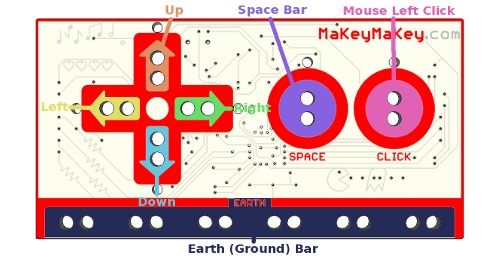
    First off, I needed to setup the MaKeyMaKey, a clever little piece of kit that enables you to use anything that conducts electricity (like, I dunno, a banana) to use as an input device for your laptop by connecting them to the board using alligator clips (like so).

    Makeymakey

    As you can see, it includes cursor keys, space and mouse click controls. By default, this would not have worked for me, as you can’t donate using these controls alone. So I had to re-program the board to use different inputs – the carriage return and tab keys. This is because you can use our new donation process to give with just a return and tab key if you’re already logged in, which is awesome, as a one-click donate process has been a goal of ours for many years.

    Step 2 – touch code (oh noes!)

    This was the tricky part. I had to download arduino (an open-source electronics prototyping platform) and follow these comprehensive instructions to install some add-ins, tweak some code and re-program the MaKeyMaKey. After a couple of failed attempts, I managed to get it to work. To be honest, after scanning the instructions, it looked a bit daunting and I nearly didn’t try, but it wasn’t that hard in the end. The instructions were ace.

    Step 3 – the potential banana skin…

    …was getting some fruit to test with. Whilst we get a delivery twice a week, it usually goes in seconds (a hungry healthy lot here) so I had to act fast. But once I commandeered some bananas from the kitchen, all I had to do was connect them to the MaKeyMaKey and log in to our test site (I’m not made of money) to try it out. And, after a few goes at trying to capture it in the measly 14 seconds you get on instagram (didn’t even bother with vine), I managed to get it to work!

    Er, what’s the point of this?

    Mainly to see if it would work. This isn’t the best reason, I’ll grant you, but hey ho – it’s all in the doing. Having said that, I backed the MakeyMakey last year on kickstarter precisely to do this sort of thing and see if I could make any fun mash-ups (literally, in the case of bananas).

    I’d quite like to test this out with some real people and see what their reaction is to using ‘different’ ways to donate, so if you have any suggestions of *things* to test to donate with (remember, must conduct electricity. And be non-weird. And legal) I’d love to hear them and maybe try them out.

  • The future of Facebook fundraising

    This is an article I wrote back in October 2012 and has just been published in the International Journal of Nonprofit and Voluntary Sector Marketing (you’ll know it as the IJNVSM). It’s predominantly based on a presentation I gave at the IoF National Convention in 2012, so some of the data is now a bit old – for the most up-to-date data check out this presentation instead – but the thoughts remain the same…

    The future of Facebook fundraising

    When people talk about Facebook in relation to charities, they often ask what the ROI is. The general perception of Facebook is that it’s not a great way to raise money, but is fantastic as a communication and community building tool. This is true, but only to a certain extent. At JustGiving, the UK’s largest online fundraising website, we have found that encouraging and enabling individual charity supporters to share their donations or updates about their fundraising events on Facebook has a great impact on amounts raised – just one share on Facebook encourages between £1 and £18 in extra donations.

    To look to the future and understand the true potential for fundraising on Facebook, it’s first necessary to look to the past. In the summer of 2007 Facebook overtook Google to become the biggest source of web traffic to JustGiving, and then at the end of 2008 Facebook started to bring us more traffic than online email. In the intervening years, Facebook has continued to grow in importance and become the primary way that people who use JustGiving to raise money for charity tell their friends about their fundraising event and ask for sponsorship.

    In 2011 alone, Facebook drove over 1 million individual donors to JustGiving, who collectively gave £22 million – of which £1 million was donated by people coming to the site from the mobile version of Facebook. By May 2012, 32% of donations on our platform came from Facebook, a 130% year on year growth. One of the ways we reacted to this growth was by building an application that people could use to donate to charity or sponsor a friend without leaving Facebook – this generated over £250,000 in the first 9 months of 2012 . Given the continuation of this growth, we expect that by 2015, 50% of donations made through JustGiving will come from Facebook.

    In a way, this growth in fundraising reflects Facebook’s own incredible growth. As of June 2012, it had 955 million monthly active users and steadily closing in on a billion users, of which 543 million users accessed the site through their mobile. In the UK, there are over 31 million active users and over half of them use the site every day. And in a study of 30,000 adults by the London Science Museum, more people would prefer to live without toilets than Facebook! (Source: The Next Web)

    So from a British perspective, the prospective audience is huge, and more importantly, hugely engaged. But how do non-profits make the most of it?

    Making the most of Facebook

    To start, organisations that have Facebook pages should make the most of its features and plan an approach that engages their online community. Advice from Facebook themselves includes setting clear guidelines about what is and isn’t acceptable to post on your wall – this will help when users veer off topic or post things you don’t approve of. It can also reduce the risk that people will leave negative comments, a fear which puts off  many first time social media users. By having clear guidelines, you can reduce that risk and give yourselves the room to ban people who don’t abide by them.

    Another useful approach is to create a ‘conversation calendar’ whereby you plan the content you will share on your page in advance. This helps create consistency of communication, as well as making sure you have a good mix of messaging – so you don’t bombard people with messages about campaigns one week and only fundraising events the next, but have a rich mix of topics that show the breadth of work your organisation is involved in.

    For more insight on using pages, see Facebook tips, Facebook studio or the Non-Profits on Facebook page.

    Share more, raise more

    At JustGiving, we have found a way to monetize Facebook by encouraging the people taking actions on our site to share them with their Facebook friends. Specifically, when someone sponsors a friend who’s taking part in a fundraising event, as soon as a donation has been successfully processed we prompt them to share a link to their friend’s fundraising page on Facebook. As some people do not like sharing how much they give to charity, or that they give to charity at all, we frame the request as a way of helping their friend raise more money. So the perception is that sharing is an altruistic act, not a way to show off their generosity.

    Whilst we promote sharing to Facebook, Twitter, LinkedIn, Google + and by email, sharing to Facebook is by far the most popular option, accounting for 90% of shares. This is not entirely surprising, given Facebook’s scale compared to the other networks and that most people will have been asked by a friend on Facebook to sponsor.

    Redeveloping our website to encourage and highlight social sharing has had a massive impact on the number of donations made, raising an extra £1 million in eight months. This is because for every share a donor makes to a social network, a certain percentage of their friends will see that message and click on a link to make another donation on JustGiving. Our data has shown that this means each share to Facebook is worth, on average, an extra £4.50. In contrast, a share to Twitter was worth £1.80 and a share on LinkedIn £3.30. From September 2011 to April 2012, Facebook sharing generated over £925,000, Twitter £55,000 and LinkedIn, £22,000.

    What has been fascinating to observe, however, is how the impact of a share on Facebook changes depending on the context of who is sharing and what they’re sharing. For example, if a donor shares a message on Facebook about them donating directly to a charity, it is worth £1 per share, but if someone shares a message about donating to a friend’s fundraising page, it is worth around £5. But if a fundraiser (ie, someone taking part in a fundraising event for a charity) themselves shares a text update about their event, it is worth around £12 per share. And then if the fundraiser records a video about their event and shares that, the average value per share increases to £18.

    In each instance, the content that is shared appears in a Facebook newsfeed in broadly the same way, but the motivation and interest of the messages is totally different. It may be self-evident on reflection that individuals in a social network are more likely to respond to someone doing something for a charity (that the network may or may not be interested in) than a person just donating to a charity (that the network may or may not be interested in), but the way we built our product and tracked the data proves that this is actual behaviour. This could be summarised as ‘the greater the effort of the individual, the greater the response from their network’.

    So what does this mean for charities wanting to use Facebook to raise money? Well, it proves that encouraging people to share their charitable actions on Facebook can help you raise more money. And that the impact of sharing varies a lot depending on the type of content being shared, so more care should be taken on how people are encouraged to share.

    Most non-profits will have a way of accepting donations online, but very few of those processes actively encourage the donor to share their donations with friends. It is clearly beneficial to prompt those donors to share their donation on social networks, but it’s important to frame that request as a way of helping the charity raise more money from their friends and not as a way of ‘showing off’. Given that each Facebook user has an average of 130 friends, just one share could reach many people that the charity doesn’t have access too – and the message may be more effective coming from that friend than from the charity itself. In addition, non-profits should encourage people to add more content to these shares – to say ‘why’ the donor gave to that charity, sharing the interesting story that motivated the donation. Encouraging donors to share their motivation will make their share on the social network much more interesting and engaging to their network and increase the impact of that share.

    Many websites enable people to share their site on Facebook or Twitter without thinking about what content is being shared. Just sharing a link and a title of a webpage isn’t going to be very interesting to the network of the person who’s sharing, so you have to both think about how to encourage the ‘sharer’ to share, and what content is going to most engage the friends of that ‘sharer’.

    To summarise, after every action someone takes on a non-profit website, whether it’s making a donation, signing up to a newsletter or registering for an event, they should be prompted to tell their friends on social networks that they did it and equally importantly why they did it.

    Where next for social sharing?

    The future for social sharing is already changing, thanks to a feature Facebook introduced at the start of 2012 – Timeline. The Timeline is a way individuals can collate all their activity on Facebook in chronological order, but it also enables application developers to add more richness to the experiences they create. Before 2012, users could only ‘like’ or ‘recommend’ things on Facebook, but Timeline allows app developers to create their own vocabulary on Facebook that more accurately describes the actions a user is taking. It also shares the content in more places on Facebook: as well as posting content in the newsfeed like most shares, the stories are shared in the ticker and on a user’s Timeline.

    For example, by connecting the music streaming service Spotify to Facebook, you can share a ‘song’ you’re ‘listening’ to, or by using the Guardian newspaper’s social reading app, you can share an ‘article’ you’re ‘reading’. In both these examples, you can set-up the app to share on your behalf so the act of listening becomes the act of sharing, and the act of reading becomes the act of sharing; you don’t have to click a ‘share’ button to tell your friends what you’re reading or sharing. Thanks to this integration, both the Guardian and Spotify experienced huge uptakes in their user base, with the Guardian going from 0 to 3.9 million active users in just a couple of months. (Source: Facebook developer blog).

    Facebook launched JustGiving’s integration in April 2012, which allows users to share the ‘donations’ they’ve made, enables fundraisers to share ‘thanks’ to their sponsors and gives people a way to ‘remember’ someone who’s passed away, on their Timeline. (Source: Facebook developer blog). In this case, the act of clicking a ‘thank’ button on JustGiving creates a story on Facebook that you ‘thank’ that sponsor, and by connecting their JustGiving and Facebook accounts, every time someone donates, a story is automatically shared on Facebook sharing the donation. All these actions are then aggregated on a user’s Timeline, showing the friends they have supported, the charities they have donated to, and the people they have thanked.

    Open graph integration (since changed)

    These aggregations are only available if you integrate with Timeline – they add richness to a user’s history with your app, showing their friends what they’ve done in a more interesting way than a single story. Since adding our Timeline integration, we’ve seen the number of referrals from user’s Timelines be almost as much as the referrals from the newsfeed. This was surprising, but it shows that Facebook users do look at other’s profiles and find the content that’s aggregated there from Timeline applications interesting enough to click on and take the same actions themselves.

    The growth of mobile

    One other way we have seen Facebook’s impact on fundraising change has been the growth of people accessing Facebook from their mobile devices. As quoted earlier, 543 million people access Facebook every month using their mobile, and this number is growing steadily. Understanding the impact of mobile optimisation as a general trend in online fundraising is important, especially in relation to social networks.

    The growth of mobile visits to JustGiving has increased massively over the last three years, from 6% in April 2010 to 15 % in April 2011, up to a massive 32% in April 2012. Building a mobile experience for those users has helped to increase conversions by those users, but the main driver of that growth is social networks, and especially Facebook. In April 2010, mobile Facebook accounted for only 0.18% of visits to JustGiving. That grew to 4% in April 2011, but by April 2012 it was responsible for bringing 11% of all traffic to JustGiving. That’s a massive growth in a short space of time, and so we are trying to give those users who come from mobile Facebook a better experience – this will be a key challenge for the future.

    One thing we have done is encourage mobile users to share their donations on Facebook, and whilst this doesn’t have the same volume as those sharing from our desktop site, it’s still generating a reasonable impact and is growing more every month. In September 2012, sharing by sponsors to Facebook on our desktop site brought in almost £140,000, whereas sharing from our mobile site brought in £27,000. We expect these numbers to start to converge over time as people become more familiar with transacting on mobile devices and technology makes this type of sharing easier for the end user.

    In summary

    Facebook is the world’s largest social network and its scale and influence cannot be ignored. In relation to fundraising, we may not yet have reached a point where charities can actively raise significant funds themselves, but their supporters certainly can. By encouraging supporters to share donations or their relationship with charities on Facebook, it can and will bring in extra donations from the friends of those supporters. It’s key to both encourage sharing andthink about what gets shared by supporters too.

    For those non-profits who have the technical capabilities, through partners or in-house development teams, Facebook Timeline gives a new and powerful way to enable sharing by doing – to add a rich layer of context and interest that makes Timeline stories and their aggregations relevant and impactful. With the recent launch of native Facebook integration in the latest Apple operating system release (iOS 6), adding a social layer to mobile experiences is now even easier and will become ever more the norm. The future is undoubtedly mobile, so understanding people’s behaviour on mobile, making the experience optimised, easy-to-use and above all social, will be essential for the non-profit looking to the future of Facebook fundraising.

  • Highlights from #iofnc 2013 – multi-channel, innovation, mobile

    I’ve been lucky enough to be at the Institute of Fundraising’s National Convention (#iofnc) this week, learning from the best minds in the UK charity sector. It’s always a great opportunity to meet fundraising friends IRL, but there have been lots of great sessions too.

    If i had to try and summarise the key trends from the last three days (from the sessions I went to), they would be…

    • Multi-channel fundraising is a must. You can’t stick to one way of talking to people anymore.
    • Innovation is more important than ever, but you have to be prepared to fail to innovate. It’s all about testing,  learning and continually iterating (and will be more and more about lean startup methodology, I suspect)
    • Mobile is a necessity, not a luxury. It’s here now, not a future trend. It also helps you simplify your products and propositions. But it’s not necessarily the holy grail in itself (see trend #1)

    To try and be more organised this year, I’ve used storify to collect mine and others’ notes on the presentations I’ve attended, and these were my top 3 highlight sessions…

    • Innovation in giving with @reubenturner and @wordofjoe
    • Mobile and digital journey at UNICEF with @spirals
    • Dryathlon and click to cure with Cancer Research UK

    I’ve embedded the relevant storifys of each session for your delectation below…

    http://storify.com/jon_bedford/bits-and-bobs-from-the-iofnc-day-2-part-2

    http://storify.com/jon_bedford/bits-and-bobs-from-the-iofnc-day-1-part-2

    And Laila’s slides below:

    http://storify.com/jon_bedford/bits-and-bobs-from-the-iofnc-day-2-part-1

    I also shared plenty more notes from sessions on crowdfunding, shaking the digital tin, the opening plenary and online video, and more

    This year I also had the pleasure of working with Merlin’s Danielle Atkinson and PayPal Giving Fund’s Nick Aldridge to put together the digital stream for the Convention, so if you do have any feedback on the digital sessions and would like more or less of certain things, drop me a line on twitter or email.

  • The Internet of Things, #leweb and other ‘zings’

    Last week I was lucky to go to Paris for le web conference, which focused on the Internet of Things (IoT). This describes the shift to a time when all your devices are connected to the Internet, and talk to each other through machine to machine (m2m) communication.

    This has been big for a while, although we maybe didn’t notice.

    https://twitter.com/chrisheuer/status/276639291034181632

    And apparently it’s going to get a hell of a lot bigger…

    Some of the many examples pitched were fitbit (tracks your activity), withings (connected bathroom scales) and SmartThings, which is a platform for connecting pretty much anything in your house to be controlled by a smartphone app – things like light switches, power sources or even knowing when someone opens your liquor cabinet…

    I can see the use cases for some things like the fitbit, but am not entirely convinced that all the examples we saw were that useful (I’m looking at you iPad on a Segway) and seemed to be solutions looking for a problem.

    For example, a live demo of showing how you can turn off a light switch in a home on the other side of the world using your phone, whilst a guy in the house looked on felt a bit pointless. The guy could quite easily just have turned the light off himself. I understand that it was a staged demo of the technology, but demo-ing something that’s not useful doesn’t’ really show any use in a product.

    I was much more taken behind the idea of Ninja Blocks, which gave you connected objects and also an open API platform to enable you to program them to do whatever you wanted. They call it the API for atoms, which is much less scary than what Brain Solis talked about in his session when he mentioned the future of connectivity being around a Human API (although if you read his explanation of the term, it’s not as scary as it sounds and is a great read).

    The story of Lockitron was pretty good too. They were rejected by Kickstarter and so decided to build their own crowdfunding platform, which enabled them to raise the small matter of $2.2 million! The lockitron works by putting the product over your house lock, and you can then use your smartphone to enter your house sans keys, or even allow other people to enter your house (great for Airbnb perhaps). They also released their crowdfunding app as an open source project so other kickstarter rejects can go their own way. Nice work.

    And then there was the muse, a connected headband thingy that would monitor your brain waves. So you can control things with your mind, I hear you say? Well, kind of. The example given was of the Le web founder Loic writing an email and the fonts changing based on his brain activity. Changing fonts? Yes, that was my reaction.

    Brain controlled fonts is not exactly earth shattering (no word on what brain waves made comic sans), but as this tech evolves it could be one to watch. Still, it has raised over $280,000 on indiegogo. Each to their own.

    And I’ll let you be the judge of how ‘wearable’ or ‘cool’ it looks…

    For some sharp contrast to all the new tech on show, Scott Harrison spoke about his story of founding charity:water. This was predictably brilliant. I’ve talked much about them in the past, so see Scott’s story in the unlikely event you’ve never heard of them. It was definitely good to see some charity involved in the conference, but the fact it was just one made it almost more annoying to see a succession of apps and stories about people making ‘cool’ technology or loads of money and not changing the world.

    #ramonwow

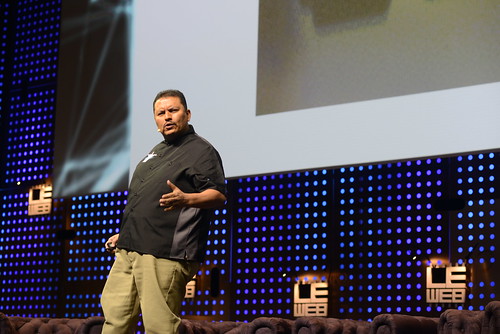
    A speaker highlight who talked about ‘real’ (ish) things amongst all the future gazing was Ramon de Leon, a social media marketer for Domino’s. I suggest you follow him and take a look at the video of his talk, as he’s a pretty entertaining guy and I can’t do his enthusiasm justice in words. But maybe a picture helps.

    Ramon de Leon, Social Media Marketing, Dominos Pizza

    I’ll leave the final word to Henri Seydoux, Founder and CEO of Parrot for adding some humour, common sense, and a quality franglais accent. He said we should be thinking in terms of “Things for the Internet, not the Internet of things”. In true stereotypical French style he then went on an extended simile about comparing “zings” to women, and how the things must be unique, like women, or you’ll get in trouble. But aside from some causal sexism, he was very good at cutting through the BS and where all this can add value.

    At one point Loic even mocked him for having a notebook with him on stage, saying that it wasn’t very connected. To which he replied, quick as a flash,

    “No it’s not connected, but it’s useful.”

    Which seems a good place to end this post. As my colleague Lee said, “people are thinking – what can we do instead of what should we do”. That was my overall impression of all the Internet of things things we saw in Paris. Yes, the tech is undoubtedly impressive, but it’s not useful enough yet. I’m sure that one day it will, possibly fairly soon, and the price of all theses devices will drop so it’ll be easier to reach a mass market, but the killer application has yet to be built (imho). Nor has anyone built a killer IoT app that will change the world and do some good. We best try and make one that does then.

    (All the sessions from le web are on YouTube, if any of this has made you want to learn more.)